Achieving High-Quality Polymer Coating
Powder coating is the final stage in the production of most metal products. Although coating accounts for a relatively small portion of the total production cost, it is the quality of the polymer coating that largely determines the overall quality of the products and drives sales growth in the highly competitive global market.
In an oversaturated market, the only path to long-term success lies in the continuous improvement of product quality. This is the key condition for a company’s survival in the ongoing competitive evolution.
What Is "Quality" in Polymer Coating?
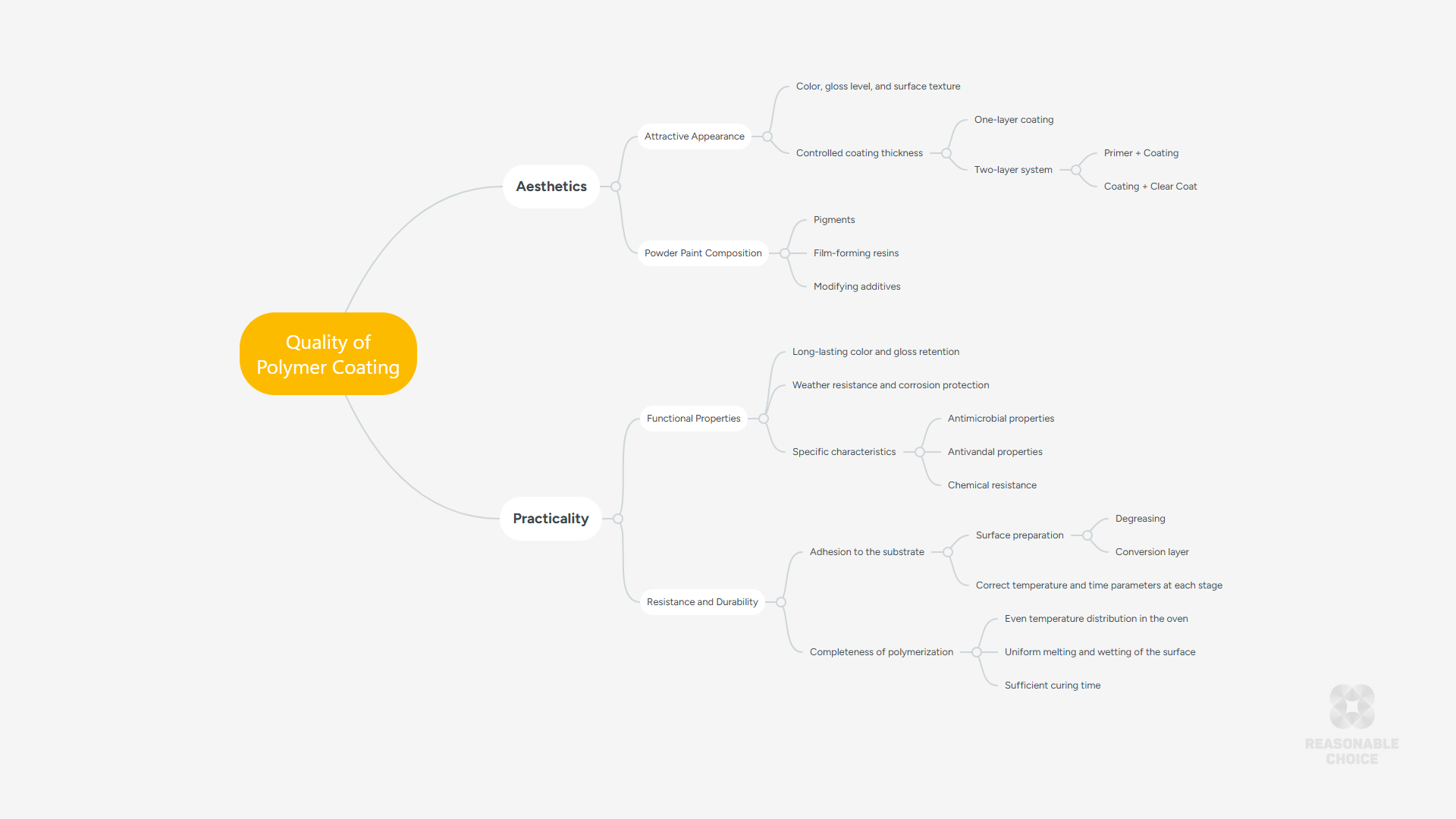
The concept of coating quality can be divided into two key aspects: aesthetic appeal and functional performance.
Aesthetic appeal is largely subjective — it depends on consumer preferences and the limitless creativity of designers. Powder coatings make it possible to achieve virtually any color, effect, gloss level, or surface texture.
Functional performance refers to corrosion resistance and mechanical durability. It ensures that the visual appearance is maintained even under harsh environmental conditions such as high humidity, UV exposure, and other aggressive factors.

High-quality polymer coating emerges where aesthetics and practicality meet.
The best coating results are achieved at the intersection of these two characteristics: visual appeal and long-lasting performance.
|
Polymer coating quality is a combination of two elements — aesthetics and practicality. Coated products must be both visually appealing and highly durable, offering strong resistance to wear, corrosion, UV radiation, and other damaging environmental factors. |
The visual appeal of a coating depends on the quality of the pigments, resins, fillers, and modifiers used in the formulation. These components can be customized to meet specific visual and design requirements.
Durability and performance are driven by adhesion — the strength of the bond between the metal surface and the polymer film. Adhesion depends on the quality of surface preparation as well as the coating’s ability to melt evenly and wet the metal surface during the curing process.
Three Core Technological Factors That Influence Coating Quality

1. Surface preparation — directly affects adhesion strength, durability, and overall resistance of the polymer coating. Surface treatment takes place in a spray tunnel where parts go through sequential stages of degreasing, rinsing, and the application of a chemical conversion layer. More about surface preparation.

2. Automated powder application — ensures even coverage and precisely controlled film thickness. Reciprocators equipped with automatic spray guns provide consistent coating quality and repeatability of the process. More about coating automation.

3. Complete curing in the oven — requires adequate dwell time and strict temperature control. Well-designed forced air circulation ensures uniform heat distribution, enabling even melting and full cross-linking of the powder coating.
We design efficient powder coating lines that deliver high-quality polymer coatings while keeping production costs to a minimum.Powder Coating Lines
Coating Quality as a Strategic Market Advantage
In a free market, product quality is the key factor in maintaining competitiveness. The final finish must meet customer expectations to the fullest — both in terms of appearance and protective, anti-corrosion properties.
"The bitterness of poor quality remains long after the sweetness of low price is forgotten."
Benjamin Franklin
The first step is to study customer needs and analyze existing products on the market. When developing new product lines with improved quality, it’s crucial to explore every possible way to enhance both functional and aesthetic performance.

Depending on the product type and category, competitive advantages may include:
- Weather-resistant coatings that allow products to be used in harsh coastal environments with intense sunlight, high humidity, and salt-laden air.
- Anti-vandal coatings with non-stick properties that simplify cleaning and restoration. Highly resistant to solvents used to remove graffiti, glue, and other contaminants.
- Antibacterial / antimicrobial coatings that make products suitable for use in public spaces such as retail stores, hospitals, sports facilities, and more.
- Chemical-resistant coatings that withstand exposure to alkalis, acids, and other aggressive substances — essential for laboratory and industrial equipment.
As customer expectations grow, so does the need to offer compelling proof of quality. The most reliable assurances are objective test results and internationally recognized quality certifications.
Reliable Methods for Assessing Coating Quality
There are reliable tools and methods for assessing the decorative qualities and physical-mechanical performance of powder coatings.
Aesthetic properties are measured using optical instruments that determine color and gloss level. Durability tests for resistance to harsh environmental conditions are conducted both outdoors under natural exposure and in accelerated laboratory settings using specialized equipment (such as salt spray chambers, thermal cycling chambers, and UV exposure chambers).
The global benchmarks for weather resistance testing include:
- Natural exposure testing in Florida, where the subtropical climate and high number of sunny days present the most aggressive natural conditions for coatings.
- Salt spray chamber tests, which simulate highly concentrated and accelerated exposure to corrosive atmospheric elements.
Outdoor and laboratory test results are correlated and calibrated to ensure accurate performance predictions. This allows manufacturers to use accelerated testing to confidently forecast the real-world durability and functional resistance of powder coatings.
Meeting certified quality standards is a prerequisite for entering global markets.
Testing in an accredited laboratory equipped with advanced tools enables the abstract concept of "quality" to be translated into measurable, quantifiable results. Successful test performance leads to certification according to internationally recognized standards.
ISO, ASTM, NACE, AAMA, and QUALICOAT certificates validate both the aesthetic and functional properties of the coating, significantly enhancing the market value of coated products.
How to Improve the Quality of Coated Products
When designing a powder coating line, we take into account the type of product, its operating environment, and the required service life. Higher product quality calls for advanced materials and up-to-date manufacturing technologies.
|
Without implementing modern powder coating technologies and using premium-quality powders and chemical agents, achieving a high-quality finish is simply not possible. |
Improving coating quality is a comprehensive task that involves:
- Choosing the right surface pretreatment cycle, including the formation of a protective conversion layer;
- Using high-quality materials — the type and formulation of chemicals and powders, which can be customized for specific applications;
- Optimizing the coating structure, including film thickness and layering — for example, primer plus coating or coating plus clear coat;
- Applying the coating automatically, ensuring consistent film thickness and repeatable results across every part;
- Utilizing a professional-grade powder coating line, where every stage of the coating process is carried out to perfection.
In a properly engineered powder coating process, adhesion, curing level, and film thickness are fully controllable parameters. We help our clients apply a scientific, data-driven approach to process improvement—tracking measurable results to continually enhance the quality of polymer coatings.
By implementing our powder coating lines, you gain not only better finish quality and performance, but also increased product competitiveness. This directly translates into higher sales and access to broader markets.